
Blog
Bihar’s White Gold: The Journey of Makhana from Pond to Plate

# Bihar’s White Gold: The Journey of Makhana from Pond to Plate
In the lush wetlands of Bihar, a remarkable agricultural tradition continues to thrive – the cultivation of makhana, often called Bihar’s “white gold.” This labor-intensive crop has sustained generations of farmers and is now gaining international recognition. Let’s dive into the fascinating journey of how these delicate seeds travel from Bihar’s ponds to plates around the world.
## The Birthplace of Excellence
Bihar dominates the global makhana market, producing over 90% of India’s total output and approximately 80% of the world’s supply. The districts of Darbhanga, Madhubani, Saharsa, and Sitamarhi are the heartland of this industry, where the perfect combination of climate, water quality, and traditional expertise creates ideal conditions for makhana cultivation.
## The Cultivation Process: An Ancient Art
### Stage 1: Pond Preparation (April-May)
The process begins with preparing shallow water bodies or specially constructed ponds. Farmers ensure the water depth is maintained at 2-4 feet, creating the perfect environment for the Euryale Fox plant to thrive.
### Stage 2: Sowing (June-July)
Seeds are sown at the onset of monsoon. The timing is crucial – too early or too late, and the entire crop can be affected. Experienced farmers have perfected this timing over generations.
### Stage 3: Growth Period (July-October)
During this period, the Euryale Fox plant grows rapidly, producing beautiful purple flowers that eventually develop into seed pods. Each pod contains 8-20 seeds. Farmers carefully monitor water levels and manage aquatic weeds.
### Stage 4: Harvesting (November-February)
This is perhaps the most challenging phase. Farmers wade into cold water, often neck-deep, to collect the seed pods by hand. They use traditional techniques passed down through generations, ensuring minimal damage to the delicate seeds.
## The Processing Journey
Once harvested, the seeds undergo a complex processing journey:
### 1. Sun Drying
Fresh seeds are spread on bamboo mats and sun-dried for 2-3 days until they reach the optimal moisture content of 12-14%.
### 2. Grading
Seeds are manually sorted by size and quality. This crucial step determines the final market grade and value of the product.
### 3. Roasting
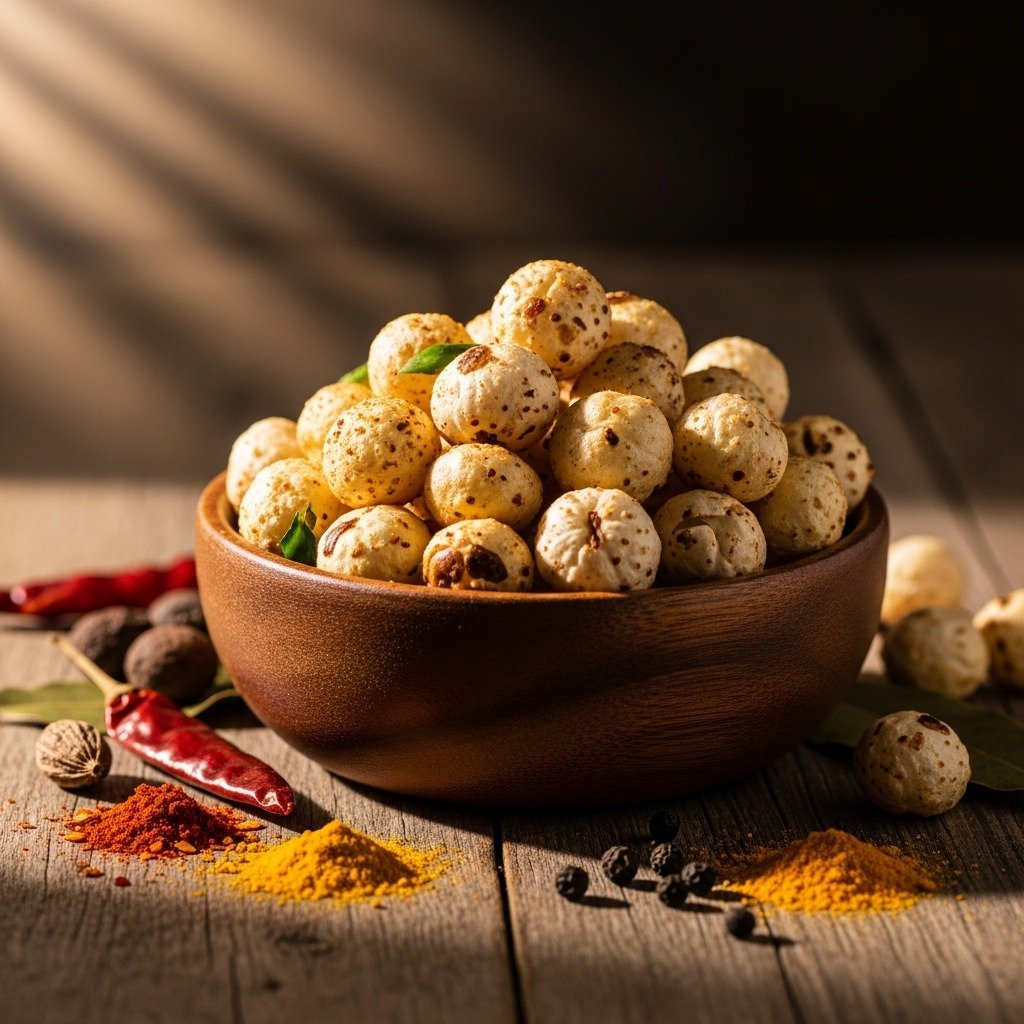
In traditional clay ovens or modern roasting equipment, seeds are heated to precise temperatures. This is where the magic happens – the black outer shell pops open to reveal the white, puffy makhana we recognize.
### 4. Hand Processing
Skilled workers then manually remove the black shells from each popped seed. This is extremely labor-intensive, with experienced workers processing 8-10 kg per day.
### 5. Final Grading and Packaging
The processed makhana is graded again based on size (lava, murra, samundi, etc.) and packaged for distribution.
## The Economic Impact
Makhana cultivation is more than agriculture – it’s a livelihood for thousands:
– **Direct Employment**: Over 100,000 farmers cultivate makhana
– **Processing Jobs**: Thousands work in processing units
– **Seasonal Income**: Provides crucial income during winter months
– **Women Empowerment**: Many processing units primarily employ women
– **Export Revenue**: Growing international demand creates valuable export opportunities
## Challenges Faced by Farmers
Despite its success, makhana cultivation faces several challenges:
1. **Climate Dependency**: Erratic rainfall and extreme weather affect yields
2. **Labor Intensive**: The manual nature of harvesting and processing increases costs
3. **Storage Issues**: Proper storage facilities are limited in rural areas
4. **Market Access**: Small farmers often lack direct market access
5. **Price Fluctuations**: Seasonal variations can impact farmer income
## Modern Innovations
Progressive companies like **N.K. Makhana Udyog** are addressing these challenges through:
– **Fair Trade Practices**: Ensuring farmers receive fair prices
– **Quality Assurance**: Implementing stringent quality control measures
– **Hygienic Processing**: Modern processing units that meet international standards
– **Direct Sourcing**: Reducing intermediaries and improving farmer margins
– **Technical Support**: Providing farmers with cultivation guidance and support
## Geographical Indication (GI) Tag
In a significant recognition of Bihar’s makhana heritage, “Makhana from Bihar” received the Geographical Indication (GI) tag. This protects the traditional knowledge and ensures that only genuine Bihar makhana can use this designation, similar to Champagne from France or Basmati from India.
## Sustainability and Future
Makhana cultivation is inherently sustainable:
– **Low Water Consumption**: Compared to other crops, it uses stagnant water effectively
– **No Pesticides**: Traditional cultivation methods rarely require chemical interventions
– **Carbon Neutral**: The aquatic cultivation process has minimal carbon footprint
– **Biodiversity**: Makhana ponds support diverse aquatic ecosystems
## The Global Journey
From Bihar’s ponds, makhana now reaches:
– Health food stores in North America and Europe
– Gourmet restaurants worldwide
– Online marketplaces globally
– Traditional Indian stores in diaspora communities
## Supporting Bihar’s Farmers
When you choose quality makhana from responsible processors, you’re not just buying a healthy snack – you’re supporting:
– Traditional agricultural practices
– Rural employment in Bihar
– Sustainable farming methods
– Women’s economic empowerment
– Preservation of cultural heritage
## Conclusion
The journey of makhana from Bihar’s wetlands to global markets is a story of tradition, hard work, and quality. Every crispy, white fox nut carries within it the legacy of generations of farmers and the promise of a sustainable, healthy future.
As consumers, understanding this journey helps us appreciate the true value of this remarkable superfood and the dedicated farmers who make it possible.